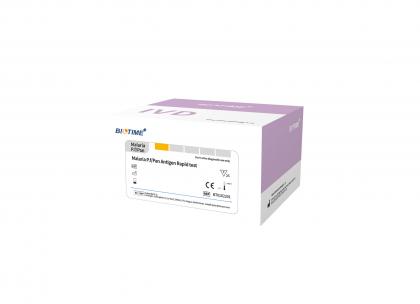
The Malaria P.f/P.v Antigen Rapid Test is a lateral flow immunoassay for the qualitative detection of Histidine-Rich Protein II (HRP-II) specific to Plasmodium falciparum (P.f) and Plasmodium lactate dehydrogenase (pLDH) specific to Plasmodium vivax (P.v) in human whole blood specimen. It is intended to be used by professionals as a screening test and provides a preliminary test result to aid in the diagnosis of infection with Malaria. For professional in vitro diagnostic use only.
Introduction Malaria is one of the most devastating infectious diseases of humans. It is problematic clinically and economically as it prevails in poorer countries and regions, strongly hindering socioeconomic development. The causative agents of malaria are unicellular protozoan parasites belonging to the genus Plasmodium. These parasites infect not only humans but also other vertebrates, from reptiles and birds to mammals. The Malaria P.f/P.v Antigen Rapid Test is a rapid lateral flow immunoassay for the qualitative detection of Histidine-Rich Protein II (HRP-II) specific to Plasmodium falciparum (P.f) and Plasmodium lactate dehydrogenase (pLDH) specific to Plasmodium vivax (P.v) in human whole blood and can give a result between 20-30 minutes by minimally skilled personnel without any laboratory equipment.
Product Features
Product Name:Malaria P.f/P.v Antigen Rapid Test
Sample Type:Whole Blood
Loading Volume:2 drops
Reaction Time:20-30 mins
Shelf Life:24 months
Storage:35.6-104°F (2-40℃)
Test Procedure The test should be operated at room temperature 59-86°F (15-30℃). 1. Allow the test cassette, specimen and buffer to reach room temperature before testing. 2. Remove the test cassette from the foil pouch and use it as soon as possible. 3. Place the test cassette on a flat and clean surface. Transfer the specimen by a pipette or a dropper: 4. Wait for the colored line(s) to appear and read the results between 20-30 minutes.
The Malaria P.f/Pan Antigen Rapid Test is a rapid lateral flow immunoassay for the qualitative detection of Histidine-Rich Protein II (HRP-II) specific to Plasmodium falciparum (P.f) and Plasmodium lactate dehydrogenase (pLDH) specific to Plasmodium species (Pan) in human whole blood specimen. It is intended to be used by professionals as a screening test and provides a preliminary test result to aid in the diagnosis of infection with Malaria. For professional in vitro diagnostic use only.
The SARS-CoV-2 Antigen Rapid Qualitative Test is a colloidal gold immunochromatography intended for the qualitative detection of nucleocapsid antigens from SARS-CoV-2 in human nasal swabs, throat swabs, and sputum from individuals who are suspected of COVID-19 by their healthcare provider. within the first five days of the onset of symptoms.
FLI-600 is a fluorescent immunoassay system with 6 channels that uses blood and urine to measure the quantitative concentration of targeted analyte. Its automated test process enables to carry out multiple simultaneous tests for six different samples.
Alpha-fetoprotein (AFP) is a protein produced primarily by the liver in a developing baby (fetus) and the portion of a developing embryo that is similar to the yolk cavity in bird eggs (yolk sac tissues). AFP levels are typically elevated when a baby is born and then decline rapidly.
CLi-1600 semi-automated device which quantifies biomarkers for thyroid disease, inflammation, cardiac diseases, fertility, diabetes, bone metabolism, anemia, and health check by analyzing human serum, plasma and whole blood.
Progesterone(PROG) is produced by the corpus luteum or in females, the male progesterone level is very low and mainly produced by adrenal cortex. Biotime PROG test is used for determining ovulation, monitoring progesterone therapy and evaluating early pregnancy status.
cTnI, a crucial cardiac biomarker, assists in detecting and managing acute myocardial infarction and assessing patient risk in cardiovascular events. Biotime's hs-cTnI offers high sensitivity, compatibility with versatile samples, and stable performance. Trust our ideal biomarker for comprehensive acute coronary syndrome evaluation.
Anti-Mullerian hormone (AMH), also known as Mullerian-inhibiting hormone (MIH), is a glycoprotein hormone structurally related to inhibin and activin from the transforming growth factor beta superfamily, whose key roles are in growth differentiation and folliculogenesis.